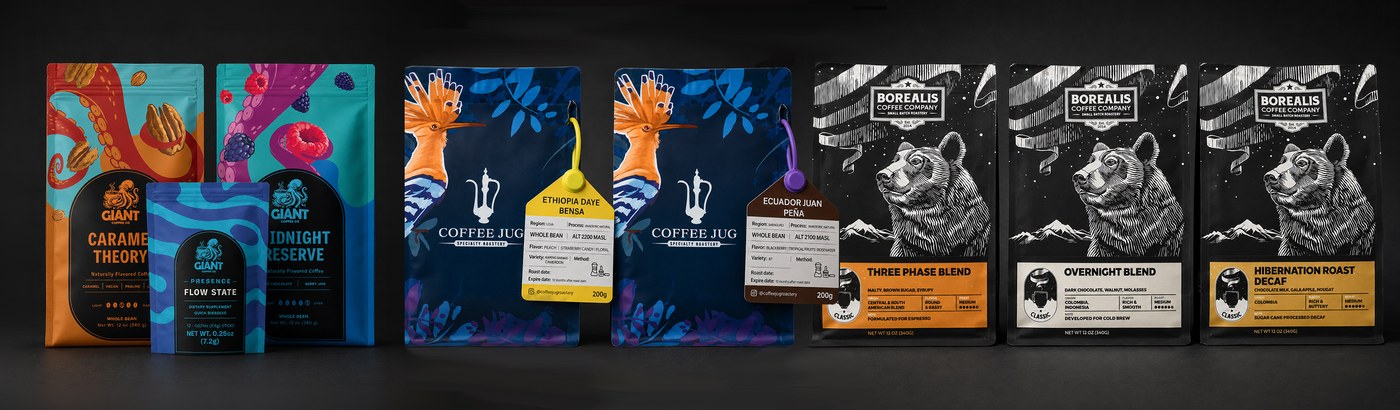
Coffee packaging design.
Bags, cans, bottles — and the system underneath them.
A tentacle that never shows the whole octopus. A bear that has held one brand together since 2017. One bird for every product line, never a recolour.
Every coffee needs its own character.
Every new release should still feel unmistakably yours.
I build illustration-led packaging systems that let a coffee range grow without going repetitive — and without losing the brand along the way.
A roastery can fail this in two directions, and both are common.
One is sameness: the same layout in nine colours, so the shelf reads as one product and the new lot you're proud of disappears into the last one.
The other is drift: every release designed on its own terms, until a customer holding two of your bags can't tell they came from the same roastery.
The way through is a rule that holds and a character that changes. Borealis kept the engraved line and the black-and-white; the range grew into cans, mugs and hoodies without breaking a line. Coffee Jug kept the indigo, the dalla and the flat cut-paper ground; every product changed the bird.
Three roasteries.
One that arrived with its logo locked, one that has been running on the same rule since 2017, and one whose range changes the character every time it grows. Three answers to the same brief: coffee packaging that keeps working as the roastery adds another origin.

Presence
GIANT Coffee Co.
How do you draw an octopus without drawing one · Rochester, NY

Longevity
Borealis Coffee
One rule since 2017, from a bag to a merch line · USA

Range
Coffee Jug
One bird per product line, never a recolour · Kuwait
All three coffee projects are above. The rest of the studio — beer, wine, spirits, food — is in the full catalogue.
A label is a rectangle.
A coffee bag is a wrap.
Front, back, two side gussets that fold out of sight and back into view on the shelf, a degassing valve punched through the artwork, and seal zones where nothing can be printed at all. The drawing has to survive all of it and still look like one thing when the bag is standing up.
Then the information has to live somewhere: brewing tips, a roast-date calendar the roastery marks by hand, origin, process, altitude, flavour, roast level, net weight. On a wine label that's a back sticker. On a coffee bag it's half the design.


How the packaging actually gets made
You choose at the start,
not at the end.
A character comes back as rough passes first, and that's where you pick — while changing direction still costs an afternoon. Once a bag looks finished it is expensive to argue with, so the argument is held early, on purpose.
After the pick, the work looks like this. The first is a tonal pass — brush, grey, the animal found rather than drawn. The second turns tone into line. The third is the engraving that went on the bag and has stayed there ever since.


What you get.
01
Print-ready files.
PDF, AI and EPS, laid into your supplier's dieline — valve, gussets and seal zones respected, so the bag maker doesn't come back with questions.
02
Mockups along the way.
A flat layout lies. Before anything is final you see the bag standing up: what the gusset folds away, what the valve sits on, what still reads from across a café.
03
Room for the next lot.
The information block is built to be swapped: origin, process, altitude and flavour change every few weeks, and they change without touching the illustration or reopening the whole layout.
Before you ask.
We rotate single origins every few weeks. New illustration each time?
No, and it would be a bad way to spend your money. A rotating lot usually needs a new sticker or a new panel inside a system that already exists — Borealis has grown that way since 2017. A new illustration is for a new line, not a new lot. The pricing for both is on the services page.
Do you work from our bag supplier's dieline?
Yes, and send it early. The dieline decides where the drawing can breathe — where the gussets fold, where the valve lands, which strips get sealed and printed over. It belongs at the start of the work, not at the end.
We're adding cold brew cans and merch. Does the system carry over?
That's what it's built for. Borealis went from one bag to cans, mugs, hoodies and a tote without breaking a line. Coffee Jug's bird moved from the beans to the cold brew and onto a tee. Say at the brief what's coming — it changes what gets built into the file.
Who supplies origin data and legal text?
You do. Region, altitude, process, varietal, roast level, net weight, the regulatory text your market requires, and the barcode — it comes in as copy, not as a layout. I set it into the design so it reads at arm's length; the content and its accuracy stay with the roastery.
Our logo already exists. Do you redo it?
Usually not. GIANT arrived with the name, logo and copy locked and wanted the illustration system around them. Coffee Jug came with its dalla. A good mark doesn't need replacing — it needs a world built to sit next to it.
Can we start with one bag?
Yes. GIANT started as two coffees, Borealis as one. The question at the brief isn't how many bags you're printing now — it's whether a range is coming, because that changes what gets built into the file.
Who draws them
45pixels is one person.
I'm Alex. I trained as a painter — easel painting, drawing, anatomy, composition, the long academic route.
Working in packaging since 2016. You talk to me, not to an account manager — there isn't one.
More about how I workOne bag, a full range,
or the whole brand world.
Three ways in, priced in the open. Tell me what you're roasting and what's coming after it — I'll tell you which chapter it is, and if it isn't a fit, I'll say so.